

Middle schoolers will tell you they are too old for picture books. Then you read one aloud, and the whole room leans in. Over the years I’ve learned that the right book can do a lot of heavy lifting in a middle school art room: it can introduce an artist, start an honest conversation about identity, get a reluctant student drawing or turn a museum into a crime scene worth investigating.
This list is for Grades 6, 7 and 8: art teachers, classroom teachers who teach their own art, homeschool families and anyone leaving plans for a substitute. Unlike my lists for younger students, it isn’t only picture books. You’ll find graphic novels about young artists, art mysteries and chapter books, artist biographies, picture books that still work beautifully with older students, and drawing and sketchbook books for the fast finisher shelf. For each of the 34 books you’ll find what it’s about, why it works in an art class, discussion prompts, an art activity, a drawing prompt, how to use it as a sub plan and which unit it ties into.
This post contains affiliate links. As an Amazon Associate I earn from qualifying purchases.
Teaching younger students too? This is the fourth and final post in my series of art book lists. You’ll also find the best art books for toddlers and preschoolers, the best art picture books for Kindergarten to Grade 2 and the best art books for Grades 3 to 5. They all live on my Art Book Lists for Kids page.
How to Use Books in a Middle School Art Class
With middle schoolers, a book is rarely the whole lesson. It’s a hook, a conversation starter or a doorway into an artist’s world. Here is how I use the different kinds of books on this list.
- Picture books: read them like illustrators. Tell students up front that the book was written for younger readers and that you’re reading it to study how it works. Older students love being let in on the craft: the materials, the layout, the color choices, where the eye goes first.
- Chapter books: book talk them. Read the first chapter aloud, show the real artwork the story is built around and leave the book where students can borrow it. A five-minute book talk at the start of class sells a book better than any assignment.
- Graphic novels: put pages on the document camera. One or two spreads are enough to talk about panels, framing, pacing and how an artist shows emotion with a few lines.
- Biographies: pair them with the real work. Put two or three of the artist’s own pieces on the board next to the book. Ask what the author chose to include and what they left out.
- Drawing books: use them as warm-ups. A five-minute prompt at the start of class builds a sketchbook habit fast, and the books give fast finishers something meaningful to do.
Every book below also has a sub plan idea. Books are one of the easiest things to leave for a substitute: the sub reads an excerpt or shows a few pages, hands out a simple page and the supplies you already have out, and students make something that connects to the story. No special art knowledge needed. For more ready-to-go ideas, my art sub plans page has plenty.
Graphic Novels About Young Artists
Graphic novels are often the first thing middle schoolers reach for in a library, and they are art. Every page is a lesson in composition, pacing, framing and character design. These stories also put young artists at the center: kids who draw, build sets, join art club and make costumes out of boxes. I keep them in the classroom library and use a few pages on the document camera to talk about how comics are put together.
1. New Kid by Jerry Craft

What it’s about: Seventh grader Jordan Banks loves nothing more than drawing cartoons about his life. Instead of sending him to the art school of his dreams, his parents enroll him in a prestigious private school known for its academics, where he is one of the few kids of color in his entire grade. Making the daily trip from his Washington Heights apartment to Riverdale Academy Day School, Jordan finds himself torn between two worlds and not really fitting into either one. It won the Newbery Medal, the Coretta Scott King Author Award and the Kirkus Prize.
Why I love it for art class: Jordan is a middle school kid who processes his life through his sketchbook, and that is exactly the habit I want my students to build. The book shows drawing as a way to think, notice and cope, not just a way to make a pretty picture. It also opens honest conversations about belonging and identity, which is right where middle schoolers live.
Talk about it: “How does Jordan use drawing to make sense of his day?” “Why do you think the author chose a graphic novel to tell this story?” “If you kept a sketchbook about your own week, what would be on the first page?”
Make it: Start a “sketchbook diary” unit. Students draw a four-panel comic about one small real moment from their week (the bus ride, lunch, a funny thing a pet did), focusing on clear panels, simple characters and speech bubbles. Drawing prompt: Draw yourself as a cartoon character in three different moods.
As a sub plan: The sub reads the first chapter aloud or shows a few pages on the document camera, then students plan and draw a one-page comic about their first day at a new school, real or imagined. Unit tie-in: SEL and identity; comics and illustration; sketchbook habits; a strong back-to-school pick for Grades 6 and 7.
2. Class Act by Jerry Craft

What it’s about: This companion book to New Kid puts Jordan’s friend Drew Ellis at the center. Eighth grader Drew has heard “you have to work twice as hard to be just as good” from his grandmother his whole life. But what if he works ten times as hard and still isn’t given the same opportunities his privileged classmates take for granted? As the pressure builds, Drew starts to feel that his good friend Liam might be one of those privileged kids, and even Jordan doesn’t know how to keep the group together.
Why I love it for art class: Readers who loved New Kid will grab this one right away, and it gives eighth graders a story told from an eighth grader’s point of view. For art class, it is a chance to look at how one artist draws the same characters across two books and how a story can be told from a different character’s eyes.
Talk about it: “How does seeing the story from Drew’s point of view change it?” “What visual clues does the artist use to show how a character is feeling?” “What is one thing you wish other people understood about you?”
Make it: Point-of-view drawing: students draw the same scene (the cafeteria, the hallway, the art room) twice, once from their own eye level and once from a very different viewpoint, like a bird’s-eye view or a worm’s-eye view. Drawing prompt: Draw a hallway at school from a bird’s-eye view.
As a sub plan: Students read or listen to a short excerpt, then design a character card for an original character: a full-body drawing plus three words that describe them and one thing they want. Unit tie-in: SEL and identity; point of view and space; character design; Grades 7 and 8.
3. Awkward by Svetlana Chmakova

What it’s about: On her first day at a new school, Penelope (Peppi) Torres trips into a quiet boy, Jaime, and the mean kids start teasing her. She panics, shoves him and runs away. Peppi finds new friends in the art club but still feels ashamed about how she treated Jaime, and it gets more awkward when it turns out he is in the art club’s archrivals: the science club. When the two clubs go to war, Peppi learns that sometimes you have to break the rules to survive middle school.
Why I love it for art class: An art club as the heart of a middle school story? My students light up at that. It shows art as a place to belong, and the art club versus science club rivalry is a fun way into the idea that art and science need each other.
Talk about it: “Why do you think Peppi joined the art club?” “What could the art club and the science club learn from each other?” “Have you ever done something you regretted and had to make it right?”
Make it: Art plus science collaboration: pair students to create an illustrated poster about a science topic they choose (the water cycle, a cell, the phases of the moon), combining accurate information with strong design. Drawing prompt: Design a logo for your school’s art club.
As a sub plan: Students design a recruiting poster for an art club: a bold title, an illustration and three reasons someone should join. Simple supplies, lots of choice. Unit tie-in: SEL and friendship; art and science (STEAM); graphic design and lettering; Grades 6 and 7.
4. Drama by Raina Telgemeier

What it’s about: Callie loves theater, but she can’t really sing, so she is the set designer for her middle school drama department’s stage crew. This year she is determined to build a set worthy of Broadway on a middle school budget, even though she doesn’t know much about carpentry, ticket sales are down and the crew members aren’t getting along. Add onstage and offstage drama and two cute brothers, and things get even crazier.
Why I love it for art class: Callie shows students that there are many ways to be creative in a production, and that set design is real art work: planning, problem solving and building on a budget. It is a great way to talk about careers in art that kids may never have thought about.
Talk about it: “What problems does Callie have to solve as set designer?” “How is designing a set different from making a painting?” “What jobs in a theater use art skills?”
Make it: Shoebox set design: students choose a scene from a favorite story and design a set for it inside a shoebox, using foreground, middle ground and background to create depth. Drawing prompt: Draw the stage set for a play that takes place on the moon.
As a sub plan: Students draw a set design on paper for a scene of their choice, labeling the backdrop, two props and where the actors will stand. Unit tie-in: Space and depth; art careers; theater and design; collaboration.
5. Making Friends by Kristen Gudsnuk

What it’s about: Sixth grade was so much easier for Dany. Now she is in seventh grade at a new middle school, her friends are in different classes and forming new groups, and she feels totally lost. When she inherits a magic sketchbook from her eccentric great-aunt, anything she sketches in it comes to life, so she draws Madison, the most perfect best friend ever. But even a friend you create isn’t guaranteed to stay your best friend, especially once she discovers she was made with magic.
Why I love it for art class: The magic sketchbook hook sells itself to middle schoolers. It is a fun way to talk about the power of drawing to imagine and invent, and the story underneath is about something every seventh grader feels: changing friendships.
Talk about it: “If anything you drew came to life, what would you be careful not to draw?” “Why do you think Dany drew a “perfect” friend?” “Is a perfect friend actually what she needed?”
Make it: Character design sheet: students invent an original character and draw a front view, side view and three facial expressions, the way professional illustrators plan characters before drawing a whole story. Drawing prompt: Draw one thing you would bring to life from a magic sketchbook, and what could go wrong.
As a sub plan: Students fold a paper into a mini sketchbook and fill four pages with the life of an original character they invent. Unit tie-in: Character design and illustration; imagination; SEL and friendship; Grades 6 and 7.
6. The Cardboard Kingdom by Chad Sell

What it’s about: A neighborhood of kids transform ordinary boxes into colorful homemade costumes and their ordinary block into a cardboard kingdom. Over one summer, sixteen kids meet knights and rogues, robots and monsters, and their own inner struggles, on one last quest before school starts again. Chad Sell created and drew the book with writing from ten other authors.
Why I love it for art class: Amazon lists this one for ages 6 to 10, so it reads young, but I include it here because the idea behind it is gold for middle school sculpture: cardboard can become anything. It is also a neat example of a collaborative book, with one artist and many writers.
Talk about it: “What everyday materials could you turn into a costume or a sculpture?” “How does the artist show that each kid has a different personality?” “Why do you think so many writers worked on one book?”
Make it: Cardboard sculpture: students design and build a wearable piece (a mask, a helmet, a shield or a crown) from cardboard, using slots, tabs and folds instead of lots of tape. Drawing prompt: Draw a costume made entirely out of things from your recycling bin.
As a sub plan: Students sketch a cardboard costume design with front and back views and a materials list. Unit tie-in: Form and sculpture; recycled materials; collaboration; design thinking.
7. The Arrival by Shaun Tan

What it’s about: A wordless graphic novel about the immigrant experience, following a new arrival on the shores of a strange, shining new city. Other authors and illustrators have praised it highly, including Art Spiegelman, who called it a documentary magically told, and Brian Selznick.
Why I love it for art class: With no words at all, students have to read the pictures, and that is a powerful art lesson in itself. The fantastical cityscapes give older students a lot to look at and talk about, and it is a natural partner for any unit on visual storytelling.
Talk about it: “How can you tell what the main character is feeling without any words?” “Which details make this city feel strange and new?” “What would feel unfamiliar to someone arriving in your town for the first time?”
Make it: Wordless sequence: students tell a short story in six panels with no words at all, using facial expressions, body language and setting to carry the meaning. Drawing prompt: Draw an object from an imaginary city that a newcomer would not recognize.
As a sub plan: The sub shows a few spreads on the document camera, then students draw a four-panel wordless story about arriving somewhere new. Unit tie-in: Visual storytelling; surrealism; empathy and SEL; social studies connections. Pair it with a lesson: my Salvador Dalí surrealist watercolor lesson for middle school.
Art Mysteries and Chapter Books
You won’t finish a chapter book in one class, and that’s fine. I use these as book talks: I read the first chapter aloud or share the setup, show the real artwork at the center of the mystery, and let the book go home with whoever can’t stand not knowing what happens next. Art mysteries are some of my favorite tools for middle school because they make students look closely at real paintings, sculptures and buildings.
8. Chasing Vermeer by Blue Balliett
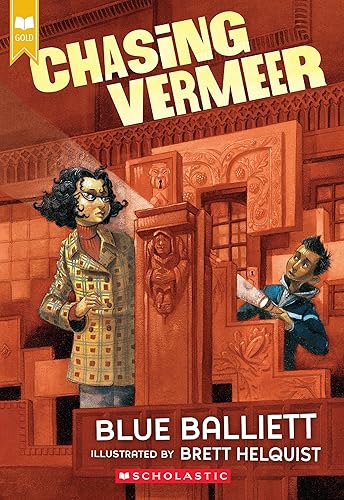
What it’s about: When a book of unexplainable occurrences brings Petra and Calder together, strange things start to happen: unrelated events connect, an eccentric old woman seeks them out and a priceless Vermeer painting disappears. The two find themselves at the center of an international art scandal and must use their intuition, problem-solving skills and knowledge of Vermeer to solve a crime that has stumped even the FBI. Illustrated by Brett Helquist.
Why I love it for art class: It is a puzzle and an art history lesson rolled into one. Students finish the book wanting to see real Vermeer paintings, and Vermeer is perfect for teaching how artists use light.
Talk about it: “Why would someone steal a famous painting?” “How do Petra and Calder use clues the way an artist uses observation?” “What makes a painting worth protecting?”
Make it: Light study: show a Vermeer painting with a window light source, then students set up a simple still life next to a window or lamp and draw it with three values: light, middle and dark. Drawing prompt: Draw an object on your desk with the light coming from one side.
As a sub plan: The sub reads the opening chapter aloud, then students draw a still life of three classroom objects lit from one side, shading the dark side of each. Unit tie-in: Value and light; artist study (Vermeer); art and mystery; Grades 6 and 7. Pair it with a lesson: my Elements of Art: Value unit.
9. The Wright 3 by Blue Balliett
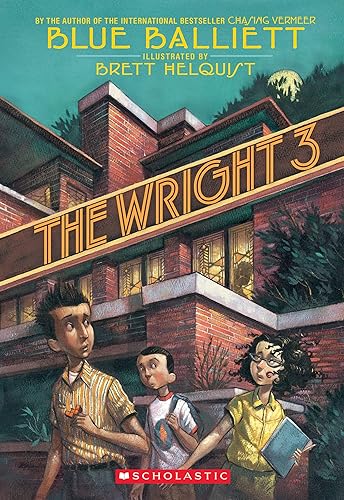
What it’s about: Petra and Calder are back, along with Calder’s friend Tommy. Unexplainable accidents and ghostly happenings throw a spotlight on Frank Lloyd Wright’s Robie House, and the three young sleuths must piece together the clues, including 3-D pentominoes and a coded message left behind by Wright.
Why I love it for art class: This one brings architecture into the art room through a mystery. Students start noticing the shapes, patterns and windows of a real building, and it is a great reason to look at how architects design.
Talk about it: “What is special about the building at the center of the story?” “How is designing a building like making a work of art?” “Which building in your town would you want to protect?”
Make it: Architectural window design: look at photographs of Frank Lloyd Wright’s geometric art glass windows, then students design their own window pattern with a ruler using straight lines, repeated shapes and a limited color palette. Drawing prompt: Draw the front of your dream house using only straight lines.
As a sub plan: Students design a geometric window pattern on graph paper with a ruler and color it with three colors. Unit tie-in: Architecture; shape, line and pattern; geometry connections; Grades 6 and 7.
10. The Calder Game by Blue Balliett

What it’s about: Calder Pillay travels with his father to a remote village in England and finds mazes, mystery and an unexpected Alexander Calder sculpture in the town square. Calder is strangely drawn to the sculpture, while other people are less friendly toward it. Then, on the same night, both the boy and the sculpture disappear, and his friends Petra and Tommy fly out to help find him.
Why I love it for art class: Alexander Calder’s mobiles are one of my favorite ways to teach balance and movement, and this book gives students a story to hang that lesson on. It is also a good conversation starter about public art and why people react to it so differently.
Talk about it: “Why might people in a small town disagree about a sculpture in their square?” “What makes a mobile different from a sculpture that stands still?” “Where would you put a giant sculpture in your town?”
Make it: Calder-inspired mobile: students cut organic shapes from cardstock and balance them on wire or straws and string, adjusting until the mobile hangs level. Drawing prompt: Draw a sculpture you would put in the middle of your town and show how people react to it.
As a sub plan: Students design a mobile on paper: draw the shapes, the arms and the strings, and write which part they think will be hardest to balance. Unit tie-in: Balance and movement; sculpture; artist study (Alexander Calder); public art. Pair it with a lesson: my Principles of Design: Movement unit.
11. From the Mixed-Up Files of Mrs. Basil E. Frankweiler by E.L. Konigsburg

What it’s about: Claudia decides to run away, and she plans very carefully: she will live at the Metropolitan Museum of Art. She brings her brother Jamie, mostly because he has money. Once they settle in, Claudia finds a statue so beautiful she cannot go home until she discovers who made it, a question that has baffled the experts too. The statue’s former owner, Mrs. Basil E. Frankweiler, holds the key. It won the Newbery Medal.
Why I love it for art class: Who hasn’t wanted to sleep over in a museum? This classic makes a museum feel like an adventure, and Claudia’s obsession with one statue is a lovely model of what it looks like to really look at a work of art.
Talk about it: “Why does Claudia care so much about who made the statue?” “Which room in a museum would you choose to sleep in, and why?” “How can you tell who made a work of art if it isn’t signed?”
Make it: Museum in a box: students curate a tiny exhibition of three artworks (their own or famous ones), design the gallery walls inside a box and write a short label for each piece. Drawing prompt: Draw yourself hiding somewhere in a museum after closing time.
As a sub plan: Students design a museum floor plan with three rooms, decide what art goes in each room and write one museum label. Unit tie-in: Museums and curating; sculpture; art history; literacy connections.
12. Under the Egg by Laura Marx Fitzgerald

What it’s about: When Theodora Tenpenny spills rubbing alcohol on her late grandfather’s painting, she discovers what seems to be an old Renaissance masterpiece underneath. That could be great news for Theo, who is struggling to hold onto her family’s townhouse, except that her grandfather was a security guard at the Metropolitan Museum of Art, and she worries the painting may be stolen. Her search for answers takes her all over Manhattan and teaches her to build a community.
Why I love it for art class: A painting hidden under another painting is a fantastic hook for talking about how artists work in layers, how art is studied and protected, and what conservators do. It pairs well with Mixed-Up Files for a New York museum mini-unit.
Talk about it: “What would you do if you found a hidden painting at home?” “Why might an artist paint over an old painting?” “Who are the people who take care of art in a museum?”
Make it: Hidden layer painting: students paint a simple background layer, let it dry, paint a new image on top, then scratch or wipe back small windows so the first layer peeks through. Drawing prompt: Draw a painting with a secret hidden somewhere in it.
As a sub plan: Students draw a picture, cover half of it with a flap of paper and draw a different scene on the flap, so the hidden picture is revealed when it is lifted. Unit tie-in: Art history (the Renaissance); painting in layers; art careers (conservation); Grades 6 and 7.
13. Masterpiece by Elise Broach

What it’s about: Marvin is a beetle who lives with his family under the kitchen sink in the Pompadays’ New York City apartment. James Pompaday is an eleven-year-old boy. After James gets a pen-and-ink set for his birthday, Marvin surprises him by creating an elaborate miniature drawing. James gets all the credit, and soon the unlikely friends are caught up in a staged art heist at the Metropolitan Museum of Art that could help recover a famous drawing by Albrecht Dürer. Illustrated by Kelly Murphy.
Why I love it for art class: A beetle who draws with pen and ink is irresistible, and it gives you a perfect reason to introduce Albrecht Dürer’s detailed drawings. It is also a great way to talk about credit, honesty and whose work is whose.
Talk about it: “Was it fair that James got the credit for Marvin’s drawing?” “Why do small, detailed drawings make us lean in?” “What tools would a tiny artist need?”
Make it: Tiny pen-and-ink drawings: students draw a miniature scene inside a 2-inch square using fine-point pens, building value with hatching, cross-hatching and stippling. Drawing prompt: Draw the world from the point of view of a beetle on the kitchen floor.
As a sub plan: Students fill a page with six small squares and practice six pen techniques (hatching, cross-hatching, stippling, contour lines, scribbles and dots), then use their favorite in a tiny drawing. Unit tie-in: Line and value; drawing techniques; artist study (Albrecht Dürer); Grades 6 and 7.
14. The Van Gogh Deception by Deron R. Hicks

What it’s about: A young boy is found in the National Gallery in Washington, DC, with no memory of who he is. As the stakes rise, he has to piece together clues about his own identity while using what he knows to stop one of the greatest art frauds ever attempted. QR codes throughout the book bring the real paintings to readers’ fingertips. It was a Sunshine State Young Readers Award nominee.
Why I love it for art class: The QR codes are the magic here: students can pull up the real paintings while they read, so the art history is built into the story. Kids who think they don’t like museums get pulled in by the thriller pace.
Talk about it: “How would you prove a painting is real or fake?” “Why do you think art forgery is such a big crime?” “Which painting from the book would you most want to see in person?”
Make it: Master study: students choose one painting from the book’s QR codes and create their own version that keeps the composition but changes one big thing (the season, the color scheme or the setting). Drawing prompt: Draw a museum guard’s view of a gallery at night.
As a sub plan: Students look at one projected painting and write three observations, then draw a small sketch of it from memory and compare. Unit tie-in: Art history; observation and close looking; artist study (Van Gogh); Grades 6 to 8.
15. The Invention of Hugo Cabret by Brian Selznick

What it’s about: Hugo is an orphan, clock keeper and thief who lives in the walls of a busy Paris train station. When his world interlocks with an eccentric, bookish girl and a bitter old man who runs a toy booth, his secret life is put in danger. A cryptic drawing, a treasured notebook, a stolen key, a mechanical man and a hidden message from Hugo’s father drive the mystery. With 284 pages of original drawings, it combines elements of a picture book, a graphic novel and film, and it won the 2008 Caldecott Medal.
Why I love it for art class: This book is a drawing lesson in disguise. Long sequences of drawings carry the story the way a film would, so students see how an artist can move from a wide view to a close-up and cut between scenes using only pictures. It is a brilliant bridge between art, storytelling and filmmaking.
Talk about it: “How do the drawings feel like a movie?” “Why do you think the author told parts of the story only in pictures?” “How do the drawings show you where the reader is looking?”
Make it: Zoom sequence: students draw a sequence of four or five pencil drawings that start wide (a whole city or building) and zoom closer and closer until they land on one tiny detail. Drawing prompt: Draw a clock face up close, with every gear and number.
As a sub plan: The sub shows a few drawing sequences on the document camera, then students draw a three-frame “zoom in” from a wide view to a close-up. Unit tie-in: Visual storytelling; value and pencil drawing; art and film; Grades 6 to 8.
16. Wonderstruck by Brian Selznick

What it’s about: Ben longs for the father he has never known. Rose dreams of a mysterious actress whose life she chronicles in a scrapbook. When Ben discovers a puzzling clue in his mother’s room and Rose reads a headline in the newspaper, both set out alone to find what they are missing. Set fifty years apart, Ben’s story is told in words and Rose’s in pictures, and the two stories weave back and forth until they come together. It has over 460 pages of original artwork and won the Schneider Family Book Award.
Why I love it for art class: One story in words and one in pictures: there is no better way to show students how much an image can say on its own. It pairs beautifully with Hugo Cabret for a unit on visual storytelling.
Talk about it: “Which story did you understand more easily, the words or the pictures? Why?” “What can a drawing show that words can’t?” “What would you keep in a scrapbook about someone you admire?”
Make it: Two ways to tell it: students write a short paragraph about a memory, then tell the same memory in three drawings, and compare which version says more. Drawing prompt: Draw a page from a scrapbook about someone you admire.
As a sub plan: Students create a scrapbook page about a person they admire, with drawings, labels and decorative borders. Unit tie-in: Visual storytelling; mixed media and collage; literacy connections; Grades 6 to 8.
Artist Biographies and Art History Books
Middle schoolers are ready for the real stories behind famous artists: the struggles, the rivalries, the failures and the stubbornness. Short biographies like these make great independent reading, research starters and sub plans. I like to pair a biography with one or two of the artist’s actual works on the board.
17. Who Was Leonardo da Vinci? by Roberta Edwards

What it’s about: Leonardo da Vinci was a gifted painter, talented musician and dedicated scientist and inventor who designed flying machines, submarines and even helicopters. Yet he had a hard time finishing things. Only thirteen paintings are known to be his, and the illustrated encyclopedia he meant to create was left as thousands of disorganized notebook pages. An accessible portrait of a fascinating man in Renaissance Italy. Illustrated by True Kelley.
Why I love it for art class: Students love hearing that one of the greatest artists who ever lived had trouble finishing his work. It makes him human, and it makes notebooks and sketchbooks feel important: Leonardo’s ideas lived on paper.
Talk about it: “Why do you think Leonardo had trouble finishing things?” “What is the difference between an artist’s notebook and a finished painting?” “Which of Leonardo’s inventions would you want to see work?”
Make it: Inventor’s notebook page: students design an invention and draw it in a notebook style, with a main drawing, close-up details, arrows, labels and notes in the margins. Drawing prompt: Draw a flying machine for your pet.
As a sub plan: Students read a chapter or two and create a Leonardo-style notebook page about something in the classroom: a careful observational drawing plus labels and questions. Unit tie-in: Artist study (Leonardo da Vinci); the Renaissance; observational drawing; art and science. Pair it with a lesson: my Emergency Art Sub Plans for Middle School (art history and value drawing).
18. Who Was Michelangelo? by Kirsten Anderson

What it’s about: Travel to Renaissance Italy and meet the young apprentice who became one of the most beloved sculptors and painters of all time. Michelangelo created some of the world’s most recognizable art, from the statue of David to the ceiling fresco of the Sistine Chapel, and he was also a gifted poet and architect. The book follows his whole life, from his apprenticeship to his relationships with popes and the Medici family to his refusal to stop working into his late eighties. Illustrated by Gregory Copeland.
Why I love it for art class: Michelangelo is a perfect match for middle school: an apprentice who became a master through years of hard work. His story is a natural way into sculpture, the figure and the Renaissance.
Talk about it: “What did Michelangelo learn as an apprentice?” “Why do you think he kept working into his late eighties?” “Would you rather carve a statue or paint a ceiling? Why?”
Make it: Subtractive sculpture: students carve a simple form from a bar of soap or a block of floral foam, planning their design on paper first and removing material slowly, the way a sculptor works with stone. Drawing prompt: Draw a ceiling you would paint for your school gym.
As a sub plan: Students tape paper to the underside of their desks and draw lying on the floor or reaching up, then write about how it felt to work like Michelangelo on the Sistine Chapel ceiling. Unit tie-in: Artist study (Michelangelo); the Renaissance; form and sculpture; Grades 6 to 8. Pair it with a lesson: my art history lessons and worksheets.
19. Who Was Frida Kahlo? by Sarah Fabiny

What it’s about: You can always recognize a painting by Frida Kahlo, because she is in nearly all of them, with her black braided hair and colorful Mexican clothing. Frida lived with serious illness for much of her life and turned herself into a living work of art. She was famous for her self-portraits and haunting imagery and for her marriage to the artist Diego Rivera, and she drew inspiration from the ancient culture and history of Mexico. Illustrated by Jerry Hoare.
Why I love it for art class: Frida’s self-portraits are a natural way into identity work in middle school. Students are fascinated by how she put her own life, culture and symbols into her paintings.
Talk about it: “Why do you think Frida painted herself so often?” “What symbols does she use to tell us about her life?” “What objects, animals or colors would you include in a self-portrait about you?”
Make it: Symbolic self-portrait: students draw a self-portrait and surround themselves with symbols (plants, animals, objects) that represent their family, culture, interests and hopes. Drawing prompt: Draw yourself with one animal and one plant that represent who you are.
As a sub plan: Students read a chapter, then plan a symbolic self-portrait on paper with five labeled symbols and a sentence explaining each. Unit tie-in: Artist study (Frida Kahlo); portraits and identity; Hispanic Heritage Month; women in art. Pair it with a lesson: my Frida Kahlo surrealist landscape lesson.
20. Who Was Vincent van Gogh? by Paula K. Manzanero

What it’s about: Vincent van Gogh sold just one painting in his lifetime and created over 2,100 artworks in just over a decade before he died at thirty-seven. Bold blues and yellows, thick paint and heavy brushstrokes define his work, which is now loved all over the world. Vincent was often lonely and struggled with his mental health, but his brother Theo always supported him, and much of what we know about Vincent comes from the hundreds of letters Theo kept. Illustrated by Gregory Copeland.
Why I love it for art class: Van Gogh’s story speaks to middle schoolers on a deeper level: persistence, loneliness, family support and the gap between how the world saw him then and how it sees him now. And his brushstrokes are a perfect way to teach texture and movement in paint.
Talk about it: “Why do you think Vincent kept painting when almost no one bought his work?” “How did his brother Theo help him?” “What do his brushstrokes make you feel?”
Make it: Expressive brushstrokes: students paint a landscape or still life using only short, thick, directional strokes, the way Van Gogh did, with oil pastels or thick tempera. Drawing prompt: Draw your bedroom using only short, curving lines.
As a sub plan: Students write a short letter from Vincent to Theo describing a painting he is working on, then sketch that painting. Unit tie-in: Artist study (Van Gogh); texture and movement; Post-Impressionism; SEL. Pair it with a lesson: my Van Gogh Irises art lesson.
21. Kid Artists: True Tales of Childhood from Creative Legends by David Stabler

What it’s about: Funny childhood biographies and full-color illustrations show how Leonardo da Vinci, Beatrix Potter, Keith Haring and fourteen other great artists handled regular-kid problems. Jackson Pollock lived in eight different cities before he was sixteen. Georgia O’Keeffe lived in the shadow of her “perfect” older brother. Jean-Michel Basquiat overcame poverty to become one of the world’s most influential artists. Illustrated by Doogie Horner.
Why I love it for art class: Every one of these artists was once a kid with embarrassing moments and big dreams. The short chapters are perfect for a quick read at the start of class, and students love finding out that the famous names on the board were once awkward kids too.
Talk about it: “Which artist’s childhood surprised you the most?” “How did their childhood show up in their art later?” “What might a book about your childhood say someday?”
Make it: Artist trading cards: each student reads one short chapter and creates a trading card for that artist, with a portrait on the front and three surprising facts on the back. Drawing prompt: Draw a famous artist as a kid, doing something ordinary.
As a sub plan: Each student reads one chapter and creates a one-page “childhood poster” for that artist with a drawing, three facts and one quote or big idea. Unit tie-in: Artist study; art history research; SEL and growth mindset; Grades 6 and 7. Pair it with a lesson: my Georgia O’Keeffe horse skull lesson for middle school.
22. 13 Artists Children Should Know by Angela Wenzel

What it’s about: A heavily illustrated introduction to some of the world’s greatest painters, from Leonardo da Vinci’s Mona Lisa and Vermeer’s depictions of light to Van Gogh’s brushstrokes and Matisse’s cutouts. The book moves in chronological order with a timeline, and each entry includes a short biography, reproductions of major works and text that speaks directly to young readers. Games, quizzes and activities, plus museum information, further reading and online resources, round it out.
Why I love it for art class: This is the book I’d keep on the shelf for quick research. The timeline gives students a sense of how art history fits together, and the reproductions are large enough to really look at.
Talk about it: “Which artist on the timeline would you like to meet?” “How did art change from the oldest artist in the book to the newest?” “Who would you add as the fourteenth artist?”
Make it: Living timeline: each student or pair takes one artist from the book and creates a small panel (a mini master study plus three facts), then the class hangs the panels in order as a hallway timeline. Drawing prompt: Draw a self-portrait in the style of your favorite artist from the book.
As a sub plan: Students choose one artist, read the entry and complete a one-page artist profile with a small sketch inspired by one of the artist’s works. Unit tie-in: Art history; artist study; research skills; a great anchor book for a year of artist studies. Pair it with a lesson: my Artist Study Collection (20 famous artist art lessons).
23. Vincent’s Starry Night and Other Stories: A Children’s History of Art by Michael Bird

What it’s about: A journey through the story of world art, from early cave paintings to the present day, told in 68 tales about artists around the world and the way they created their work. Written by educator and art historian Michael Bird and illustrated by Kate Evans, it also includes reproductions of the artworks discussed, a timeline and feature spreads on places connected with art.
Why I love it for art class: Sixty-eight short stories means you can read one at the start of class all year long. It covers art from around the world, not just Europe, which makes it a great base for a global art history unit.
Talk about it: “Which story would make the best movie?” “What did the artists in different times and places have in common?” “Why do people in every culture make art?”
Make it: Art history story slam: each student picks one story, retells it in a six-panel comic and presents it to the class in under two minutes. Drawing prompt: Draw a cave painting about something that happened in your life this week.
As a sub plan: The sub reads one or two stories aloud, then students create a postcard: a drawing inspired by the artwork on the front and a note to a friend about the artist on the back. Unit tie-in: Art history; art around the world; storytelling; Grades 6 to 8. Pair it with a lesson: my Van Gogh Starry Night pop art lesson.
Picture Books That Still Work in Middle School
Don’t put the picture books away when students hit sixth grade. A well-made picture book biography is a five-minute way to introduce an artist, and older students notice the illustration choices younger kids miss. Several of these are written for younger readers, so I frame them honestly: “This was written for little kids. Let’s read it like illustrators and figure out how it works.”
24. Leonardo: Beautiful Dreamer by Robert Byrd

What it’s about: Leonardo da Vinci was famous in his time as a painter, prankster and philosopher, and he was also a musician, sculptor and engineer for dukes, popes and kings. Robert Byrd’s picture book celebrates his passionate, playful genius in twenty spreads full of side drawings, extra text and quotes from Leonardo’s own writings, covering his art, jokes, explorations and inventions.
Why I love it for art class: The pages are packed with side drawings and notes, just like Leonardo’s own notebooks, so it is a perfect model for a sketchbook page. Pair it with Who Was Leonardo da Vinci? for a Leonardo week.
Talk about it: “Which of Leonardo’s many jobs surprised you?” “How do the side drawings and notes change the way you read each page?” “Why might a curious person never finish everything they start?”
Make it: Curiosity page: students choose one question about the world (How do birds fly? Why do leaves change color?) and fill a page with drawings, diagrams and notes as they investigate it. Drawing prompt: Draw a machine that does your least favorite chore.
As a sub plan: Students read the book and make a “Leonardo notebook page”: a large observational drawing of a hand, a shoe or a plant with labels written around it. Unit tie-in: Artist study (Leonardo da Vinci); the Renaissance; sketchbooks; art and science.
25. Viva Frida by Yuyi Morales

What it’s about: Author and illustrator Yuyi Morales illuminates Frida Kahlo’s life and work in an elegant picture book. Frida’s life was full of laughter, love and tragedy, and all of it shaped what she painted. Photography is by Tim O’Meara. It is a 2015 Caldecott Honor Book and won the 2015 Pura Belpré Illustrator Award.
Why I love it for art class: This one is written for young readers, but it is a gorgeous example of an illustrator making careful choices. I use it with older students as an “illustrators at work” study and pair it with Who Was Frida Kahlo? so students compare two very different ways of telling the same artist’s story.
Talk about it: “How is this book different from a regular biography?” “What choices did the illustrator make, and why do you think she made them?” “How would you tell an artist’s life story in very few words?”
Make it: Minimal-text picture book: students create a four-page mini book about an artist they admire, using only one short sentence per page and letting the illustrations do most of the work. Drawing prompt: Draw yourself in the middle of a dream.
As a sub plan: Students compare the two Frida books with a simple Venn diagram, then draw one page for their own version of Frida’s story. Unit tie-in: Artist study (Frida Kahlo); illustration; Hispanic Heritage Month; women in art. Pair it with a lesson: my Frida Kahlo portrait lesson.
26. Yayoi Kusama: From Here to Infinity! by Sarah Suzuki

What it’s about: Written by Sarah Suzuki, a curator at The Museum of Modern Art in New York, with illustrations by Ellen Weinstein and reproductions of the artist’s work, this book tells the story of Yayoi Kusama. Growing up in the mountains of Japan, she dreamed of becoming an artist. One day she had a vision in which the world and everything in it was covered in polka dots, and she began covering her paintings, drawings, sculptures and even her body with dots. As she traveled the world, she brought her dots with her.
Why I love it for art class: Kusama is a favorite with middle schoolers, and the reproductions of her real artwork in this book make it a step up from a simple picture book. It is a great way to talk about pattern, repetition and how one simple idea can become an artist’s whole world.
Talk about it: “Why do you think dots became so important to Kusama?” “Some people see her dots as tiny cells and others as giant planets. What do you see?” “Is there a shape, color or symbol you could use again and again in your own art?”
Make it: Infinity pattern: students choose one simple shape and use it to cover a drawing of an object or a room, varying size, color and spacing to create rhythm and depth. Drawing prompt: Draw your shoe covered in a pattern that never ends.
As a sub plan: Students draw a simple object outline and fill it, and the background, with a dot pattern using markers, changing the dot size to show where the light falls. Unit tie-in: Pattern and rhythm; artist study (Yayoi Kusama); contemporary art; women in art. Pair it with a lesson: my Yayoi Kusama mushroom pattern lesson.
27. A Life Made by Hand: The Story of Ruth Asawa by Andrea D’Aquino

What it’s about: Ruth Asawa (1926 to 2013) was an influential Japanese American sculptor and activist who worked tirelessly for arts education. Inspired by the world around her, she saw beauty in ordinary things like spiderwebs, insect wings and drops of water in the garden on her family’s farm. She studied at Black Mountain College, an unusual school full of brilliant thinkers. “An artist,” she said, “is an ordinary person who can take ordinary things and make them special.”
Why I love it for art class: That quote alone is worth the book. Asawa’s story is about noticing, and it gives middle schoolers permission to find art in everyday things. Her fight for arts education also makes a meaningful conversation in an art room.
Talk about it: “What ordinary things did Ruth Asawa find beautiful?” “What does her quote about artists mean to you?” “Why do you think she cared so much about arts education?”
Make it: Ordinary made special: students choose one ordinary object (a paper clip, a leaf, a bottle cap), draw it large and detailed, then repeat or transform it into a design or sculpture. Drawing prompt: Draw a spiderweb, a leaf or a drop of water as large as the page.
As a sub plan: Students go on a “beauty in the ordinary” hunt around the classroom, sketch five small things they find interesting and develop one into a large drawing. Unit tie-in: Artist study (Ruth Asawa); form, line and sculpture; observation; women in art.
28. Building Zaha: The Story of Architect Zaha Hadid by Victoria Tentler-Krylov

What it’s about: Zaha Hadid grew up in Baghdad, a city full of thinkers, artists and scientists, and knew from a young age that she wanted to be an architect. A woman in a man’s world and a person of color in a white field, she met resistance at every turn. Critics called her a diva and said her ideas were unbuildable, but she kept setting goals and finding new ways to build projects that became famous around the world.
Why I love it for art class: Architecture is art that students live inside every day, and Zaha Hadid’s flowing, unexpected buildings are a great way to show that buildings don’t have to be boxes. Her persistence is a strong message for students who have been told their ideas won’t work.
Talk about it: “Why did people say her ideas were unbuildable?” “How did she respond to the people who doubted her?” “What would a building that doesn’t look like a box look like?”
Make it: Curved architecture: students design a building using only curved lines, then build a small model from strips of cardstock bent into flowing shapes. Drawing prompt: Draw a school building that has no straight lines.
As a sub plan: Students design a building for a place they love (a skate park, a library, a pool) using curved lines, and write two sentences about why they chose its shape. Unit tie-in: Architecture; line and form; women in art and design; perseverance.
Drawing Books and Sketchbook Starters
These aren’t read-alouds; they are books you hand to a student who finishes early, keep on the fast finisher shelf or use for a week of sketchbook warm-ups. Middle schoolers who say “I can’t draw” often just need permission to play on paper, and that’s what these books are for.
29. The Bird King: An Artist’s Notebook by Shaun Tan

What it’s about: A collection of sketches, artwork and personal reflection from Shaun Tan, author and illustrator of The Arrival. It is a window into the creative process: the stops and starts, the ideas that never took off and the ones that grew into something much bigger. Tan writes that when he faces a blank page and feels uninspired, there is only one thing to do: just start drawing.
Why I love it for art class: Middle schoolers often believe real artists simply have good ideas. This book shows the messy middle: the sketches that went nowhere and the ones that grew. Amazon lists it for ages 12 and up, so it is ideal for seventh and eighth graders.
Talk about it: “What does Shaun Tan do when he feels uninspired?” “Why would an artist share sketches that didn’t work?” “What is one idea you’ve had that never got finished?”
Make it: Just start drawing: students set a timer for ten minutes and fill a page with quick, unplanned sketches, then circle the one with the most potential and develop it into a finished piece the next class. Drawing prompt: Draw a bird that is also a king.
As a sub plan: Students fold a page into eight boxes and draw eight quick ideas for a creature, then choose one to draw large and in detail. Unit tie-in: Sketchbooks and the creative process; illustration; surrealism; Grades 7 and 8. Pair it with a lesson: my Max Ernst surrealist bird lesson.
30. Draw 50 Animals by Lee J. Ames

What it’s about: A step-by-step drawing book that helps kids and adults build their technical drawing skills and a collection of animal subjects, from a lion, giraffe and penguin to a dinosaur, a bunny and a shark. Lee J. Ames’s Draw 50 method has been used for decades by artists from beginner to advanced levels.
Why I love it for art class: Step-by-step books build confidence, especially for students who freeze in front of a blank page. I use them as a starting point: follow the steps once, then change the pose, the setting or the style so the drawing becomes your own.
Talk about it: “What basic shapes does each animal start with?” “How can you change a step-by-step drawing so it becomes yours?” “Which animal was hardest to draw, and why?”
Make it: Draw it, then make it yours: students draw one animal from the book, then redraw it in a new setting with shading, texture and an original background. Drawing prompt: Draw an animal using only circles and ovals first, then add the details.
As a sub plan: Students choose two animals from the book, draw each one following the steps, and then add a background that tells a story about where the animal lives. Unit tie-in: Shape and form; drawing skills; fast finishers; Grades 6 and 7. Pair it with a lesson: my gray whale value lesson in soft pastel.
31. Art2-D2’s Guide to Folding and Doodling by Tom Angleberger

What it’s about: The activity book companion to the Origami Yoda series. Kellen and the kids from McQuarrie Middle School, with help from Art2-D2, present more than 75 activities inspired by the series, including doodling, folding and cartooning.
Why I love it for art class: Students who loved the Origami Yoda books will dive right in, and it gives reluctant artists a playful, low-pressure way to draw every day. It is a fun one to keep on the fast finisher shelf.
Talk about it: “What makes a doodle different from a drawing?” “How do cartoonists show a lot with a few lines?” “What character would you invent for your own origami series?”
Make it: Doodle to design: students start with a page of free doodles, choose their favorite shapes and turn them into a repeated pattern or a cartoon character. Drawing prompt: Draw a robot sidekick for yourself.
As a sub plan: Students work through a few doodle activities, then design an original paper character and draw a short comic starring it. Unit tie-in: Line and doodling; cartooning; paper folding; fast finishers. Pair it with a lesson: my line landscape zentangle lesson.
32. Wreck This Journal: Now in Color by Keri Smith

What it’s about: A full-color edition of the bestselling Wreck This Journal, made for its tenth anniversary. Inside are prompts for painting, shredding, transforming and experimenting with color: mixing colors to make mud, letting chance pick your color, weaving with brightly colored paper strips and more.
Why I love it for art class: Perfectionism is a big deal in middle school. A book that asks you to make a mess on purpose is the perfect antidote, and the color prompts sneak in real color mixing and experimentation.
Talk about it: “How does it feel to make a mess on purpose?” “Which prompt would be hardest for you to do?” “What did you learn about color from a prompt that “went wrong”?”
Make it: Wreck a page: students create their own class “wreck it” prompts, swap them with a partner and complete each other’s prompts on a sketchbook page. Drawing prompt: Fill a page using only the color you like least.
As a sub plan: Students complete three color experiment prompts (mix a color, let chance pick a color, weave paper strips) and write one sentence about what they discovered. Unit tie-in: Color and experimentation; creativity and perfectionism; sketchbooks. Pair it with a lesson: my winter creativity challenge cards and drawing prompts.
33. How to Be an Explorer of the World: Portable Life Museum by Keri Smith

What it’s about: An interactive guided journal about the art and science of everyday life. Artists and scientists study the world in surprisingly similar ways: observing, collecting, documenting, analyzing and comparing. Through hand-illustrated prompts, readers are encouraged to observe the world as if they have never seen it before: take notes, collect things, notice patterns, copy, trace and focus on one thing at a time.
Why I love it for art class: This is my favorite book for teaching that art starts with noticing. The prompts get students looking at textures, patterns and colors they walk past every day, and they connect beautifully to science class.
Talk about it: “How are artists and scientists alike?” “What is something you walk past every day but have never really looked at?” “What would you put in a museum about your life?”
Make it: Portable museum: students collect ten small found objects or rubbings from around the school, arrange and label them in a box or on a page, and add observational drawings of three of them. Drawing prompt: Draw five different textures you can find in this room.
As a sub plan: Students take a quiet observation walk around the classroom, make rubbings of three textures and draw three small objects with labels and notes. Unit tie-in: Texture and observation; art and science; collecting and curating; sketchbooks.
34. Steal Like an Artist by Austin Kleon

What it’s about: Austin Kleon’s guide presents ten principles for discovering your artistic side and building a more creative life. Nothing is completely original, he argues, so embrace influence, learn from the work of others, remix and reimagine to find your own path. Follow your interests wherever they lead, and make the work you want to see in the world.
Why I love it for art class: This one is written for grown-ups, so I preview it and share short sections with older students rather than handing it over whole. The big idea, learning from other artists without copying, is exactly the conversation eighth graders need, and it’s a great book for your own desk too.
Talk about it: “What is the difference between copying and learning from another artist?” “Whose work has influenced yours?” “How can you mix two influences to make something new?”
Make it: Influence map: students choose three artists they admire, make a small study of something from each, then create one original piece that combines an idea from all three. Drawing prompt: Draw something new by combining two things you love.
As a sub plan: Students write down three artists, characters or styles that inspire them, then create a drawing that blends two of those influences into something new. Unit tie-in: Creativity and originality; artist influence; Grade 8 and teachers.

Quick Tips for Books in a Middle School Art Room
- Build a small classroom library. Even ten art-themed books on a shelf by the door get borrowed. Graphic novels go first.
- Try a book pair. Who Was Frida Kahlo? with Viva Frida; Who Was Leonardo da Vinci? with Leonardo: Beautiful Dreamer; Mixed-Up Files with Under the Egg; Hugo Cabret with Wonderstruck. Ask students how the two books tell their stories differently.
- Put the real art next to the book. Whether it’s a Vermeer from Chasing Vermeer or a Calder mobile from The Calder Game, show the actual artwork and let students compare.
- Keep sketchbooks going. A short drawing prompt after a book talk is the easiest way to build a daily drawing habit.
- Let students lead. Middle schoolers can book talk a title to the class, or read a picture book to a younger buddy class and teach the art activity themselves.
Keep the Art Going
If you’d like your books and your art lessons to line up all year, my K–8 Art Curriculum Map lays out 36 weeks of art lessons for every grade from Kindergarten to Grade 8, with a picture book suggestion for many of the weeks. You’ll find grade-by-grade ideas on my middle school art lessons page and my Grade 6, Grade 7 and Grade 8 pages, and more artist ideas on my famous artist art lessons page.
Want a few lessons to try right away? Join my Free Art Lesson Library. It’s free, and new lessons land in your inbox. And when you’re ready for a full year of art lessons, videos and printables in one place, take a look at the Artastic Collective.
Teaching younger students too? Don’t miss the best art books for toddlers and preschoolers, the best art picture books for Kindergarten to Grade 2 and the best art books for Grades 3 to 5. All four lists live on my Art Book Lists for Kids page. You can also find my own art activity books for kids on my Ms Artastic bookshelf.
Happy reading, and happy creating!
This post contains affiliate links. As an Amazon Associate I earn from qualifying purchases.
Share this:

Did this help? Leave a reaction
Let's talk about it. Have a question, a photo-worthy result, or a tip for other teachers? Drop it in the comments below.
💬 Leave a comment


