

People sometimes assume picture books are just for little kids. In my art room, some of the best conversations I’ve ever had with nine and ten year olds started with a picture book. Older students notice so much more: the way an illustrator layers collage, how an artist’s life shows up in their paintings, why one bright color pulls your eye across a page. A good picture book can introduce an artist, teach a technique and start a real discussion in under ten minutes.
This list is for Grade 3, Grade 4 and Grade 5: art teachers, classroom teachers who teach their own art, homeschool families and anyone leaving plans for a substitute. I’ve gathered 34 picture books that work beautifully with upper elementary students, from artist biographies and stories about creativity to books about murals, architecture and art and science. For each one you’ll find what it’s about, why it works in an art class, discussion prompts, an art activity, a drawing prompt, how to use it as a sub plan and which unit it ties into.
This post contains affiliate links. As an Amazon Associate I earn from qualifying purchases.
Teaching younger students too? This is the third post in my series of art book lists. You’ll also find the best art books for toddlers and preschoolers and the best art picture books for Kindergarten to Grade 2, and a middle school list is on the way. They all live on my Art Book Lists for Kids page.
How to Use Read-Alouds in a Grades 3 to 5 Art Class
With older students, the read-aloud is a launch pad, not the whole lesson. Here is the rhythm I use.
- Read for the story first. Let students enjoy it all the way through. Upper elementary students are often a little skeptical of picture books at first; a good story wins them over quickly.
- Go back and read like an artist. Choose two or three spreads and ask, “What choices did the illustrator make here?” Talk about materials, color, composition and where your eye goes first. This is where the art vocabulary grows.
- Connect to the real art. For artist biographies, show two or three of the artist’s actual works on the board next to the book. Ask students what the author chose to include and what they left out.
- Borrow one big idea. Pick one technique or concept (Matisse’s drawing with scissors, Hopper’s light and shadow, Rousseau’s overlapping leaves) and build the lesson around it. Students should make something of their own, not copy a page.
- Make room for writing and reflection. A short artist statement, a sketchbook note or a “What would I have done differently?” question works well at this age and ties art to literacy.
Every book below also has a sub plan idea. Picture books are one of the easiest things to leave for a substitute: the sub reads the book, hands out a simple page and the supplies you already have out, and students make something that connects to the story. No special art knowledge needed. For more ready-to-go ideas, my art sub plans page has plenty.
Picture Books About Creativity, Mistakes and Finding Your Voice
Grades 3 to 5 is when the inner critic gets loud. Students start comparing their work to the person next to them, and “I’m not good at art” creeps into the room. I keep these books close for the first weeks of school and for any day a class needs a reset. They make it safe to try, fail, change course and try again.
1. The Most Magnificent Thing by Ashley Spires

What it’s about: A girl and her best friend, a dog, set out to make the most magnificent thing. She knows exactly how it will look and how it will work. But making it is anything but easy: she tries and fails again and again, gets really, really mad and quits. A walk with her dog clears her head, and she comes back to her project with fresh eyes and gets it just right.
Why I love it for art class: Upper elementary students know this feeling well. By Grade 3 the gap between what they picture in their heads and what ends up on the paper starts to bother them, and many decide they are “not good at art.” This book names that frustration honestly and shows a way through it: step away, look again, keep the parts that work. It is also a perfect lead-in to any design or building challenge.
Talk about it: “What did the girl do when her first try did not work?” “Which parts of her ‘failed’ inventions ended up in the final one?” “What do you do when a project is making you frustrated?”
Make it: Run a cardboard and tape “magnificent thing” challenge. Give each student a small bag of recycled materials and one problem to solve (a machine that waters a plant, a tool for carrying three pencils). Students sketch a plan first, build, test and write down one change they made along the way. Drawing prompt: Draw an invention that would make your morning easier, and label three of its parts.
As a sub plan: Read the book, then students design an invention on paper: a labeled diagram with a name and a short “how it works” paragraph. No building supplies needed. Unit tie-in: SEL and growth mindset; design thinking and STEAM; a great first-week book for Grades 3 and 4.
2. Art & Max by David Wiesner

What it’s about: Max and Arthur are lizard friends who both love painting. Arthur is an accomplished painter; Max is a beginner. Max’s very first try with a paintbrush sends the two friends on a whirlwind trip through one art medium after another, and each one has its own surprises. Max is new to all of it, but he is brave and a quick learner, and his energy carries the adventure to its happy ending.
Why I love it for art class: Wiesner changes his own technique as the story moves through different media, so the book is a ready-made lesson in how the materials an artist chooses change the look and feel of a picture. Older students love spotting the shifts. It is also a funny, warm look at the expert and the beginner, which fits any class with a wide range of skill levels.
Talk about it: “How does the art change as the story moves along? Find a page where the materials look different.” “How are Arthur and Max different as artists? How are they alike?” “Which art material would you like to try that you have never used before?”
Make it: Set up a “media sampler.” Students fold a large paper into six boxes and draw the same simple subject (a lizard works well) in six materials: pencil, marker, crayon, oil pastel, watercolor and torn paper. Finish with a short reflection on which material felt most like them. Drawing prompt: Draw the same lizard twice: once with careful outlines and once with only splashes of color.
As a sub plan: Read the book, then leave a page folded into four boxes. Students draw the same animal four ways with whatever materials the sub has on hand (pencil, crayon, marker, colored pencil). Unit tie-in: Art materials and media; line and color; SEL (beginners and experts, trying new things).
3. Willow by Denise Brennan-Nelson and Rosemarie Brennan
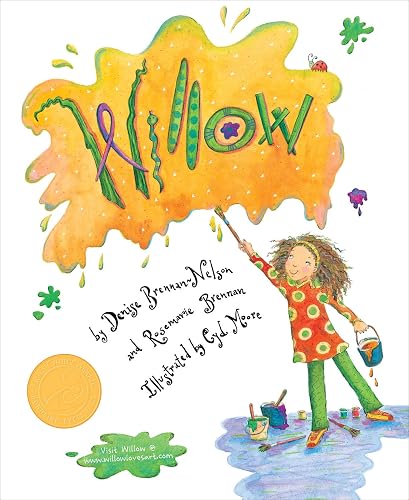
What it’s about: Miss Hawthorn’s classroom is neat and tidy; not a pencil or paintbrush is out of place, and that is how she likes it. She likes trees colored green and apples painted red. Then Willow joins her class. Willow doesn’t color inside the lines, she breaks crayons, and she sees pink trees and blue apples. As Willow’s imagination runs free, Miss Hawthorn’s idea of what art can be is changed for good.
Why I love it for art class: This one is as much for us as for the students. It opens a real conversation about whether art has to look “right,” and it gives quieter, more cautious students permission to make bold, unexpected choices. In Grades 3 to 5 it pairs beautifully with an expressive color lesson.
Talk about it: “Why do you think Miss Hawthorn liked things to look a certain way?” “What did Willow see that other people did not?” “Is there a ‘right’ color for a tree? Why or why not?”
Make it: Expressive color landscape: students draw a simple landscape (a tree, a hill, a house, a sun) and paint or color it using only “unexpected” colors, then write two sentences about the mood their color choices create. Drawing prompt: Draw an apple, a tree and the sky in colors you would never see in real life.
As a sub plan: Read the book, then students color a simple tree or fruit drawing three times: once in realistic colors, once in warm colors and once in “Willow colors.” Unit tie-in: Element of art: color (expressive and arbitrary color); SEL (being yourself); a good start to a Fauvism or Expressionism study.
4. The Art of Miss Chew by Patricia Polacco

What it’s about: After a summer with her artist grandmother, Trisha knows she wants to be an artist too. Her sketches earn her a place in Miss Chew’s special art class at the high school. When a substitute teacher tells her she is wasting time on art when she should be studying, Trisha and Miss Chew stand up for what matters. It is a true story about how much one teacher can mean to a child, and about the power of art itself.
Why I love it for art class: Students who struggle in other subjects often find their footing in the art room, and this book honors that. It is a lovely read for the start of the year, for Teacher Appreciation Week or any time you want students to think about how they learn best.
Talk about it: “How did Miss Chew help Trisha?” “Why do you think the substitute felt art was a waste of time? Do you agree?” “Who is someone who has helped you get better at something?”
Make it: Observational drawing practice, the way Miss Chew teaches: set up a still life of three everyday objects and have students draw it slowly, looking at the objects more than the paper. Then do a second drawing in half the time and compare. Drawing prompt: Draw a teacher, coach or grown-up who helped you learn something, doing the thing they taught you.
As a sub plan: Read the book, then students write a thank-you note to a teacher and illustrate it with a detailed drawing of something they learned in that teacher’s class. Unit tie-in: SEL (learning differences, perseverance, gratitude); observational drawing; Teacher Appreciation Week.
5. Drawn Together by Minh Lê, illustrated by Dan Santat

What it’s about: When a young boy visits his grandfather, they don’t share a common language, and the visit fills up with confusion, frustration and silence. Then they sit down to draw together, and something magical happens. Through a shared love of art and storytelling, the two build a bond that goes beyond words.
Why I love it for art class: This is the book I reach for to show older students that art is a language. The boy and his grandfather can’t talk to each other, but they can draw together, and that is where their bond begins. Ask students to look closely at how the pictures change once the two start drawing side by side. It also opens gentle conversations about family, culture and connection.
Talk about it: “What changes in the pictures once the boy and his grandfather start drawing together?” “How can a drawing say something that words cannot?” “Who would you like to make art with, and what would you draw?”
Make it: Partner “drawn together” pictures: two students share one large paper. Each starts on opposite sides in their own style, and they work toward the middle until their drawings connect into one scene. Finish with a joint title. Drawing prompt: Draw yourself and someone you love doing something you both enjoy.
As a sub plan: Read the book, then pair students to make a “conversation drawing”: they take turns adding one thing at a time to the same paper without talking. Unit tie-in: Illustration and style; SEL (family, belonging, communication); collaborative art.
6. Journey by Aaron Becker

What it’s about: A lonely girl draws a magic door on her bedroom wall and steps through it into a world full of wonder, adventure and danger. With a red marker in hand, she draws a boat, a balloon and a flying carpet to carry her on a spectacular journey. When she is captured by a sinister emperor, only an act of courage and kindness can set her free. A wordless Caldecott Honor book.
Why I love it for art class: Wordless books are gold in upper elementary. Every student “reads” it at the same level, and they have to slow down and look closely at the pictures to follow the story. The single red color against the detailed world is a perfect example of emphasis, and the “draw what you need” idea gets students imagining instantly.
Talk about it: “How does the illustrator use the color red? Why do you think he chose only one bright color?” “What would you draw if you had the girl’s marker?” “The book has no words. How did you know what was happening?”
Make it: Emphasis drawing: students draw a detailed scene in pencil or black pen, then add one object in a single bright color (red marker or crayon) that “changes” the story. Add a short caption telling what the object does. Drawing prompt: Draw a door on a wall and show what is on the other side.
As a sub plan: Students “write” the words for three pages of the book, then draw their own magic door page with one object in red. Works well with just pencils and one red crayon each. Unit tie-in: Principle of design: emphasis; visual storytelling and illustration; imagination and narrative writing.
Picture Books About Famous Painters
Upper elementary students are ready for real art history. These picture-book biographies give each artist a story, a struggle and a personality, so the paintings stick. Each one leads into a lesson that borrows the artist’s big idea, not a copy of a famous painting.
7. Vincent Can’t Sleep: Van Gogh Paints the Night Sky by Barb Rosenstock, illustrated by Mary GrandPré

What it’s about: Vincent van Gogh often couldn’t sleep, so he wandered out under starlit skies: through the garden, past the church with its tall steeple, down rolling hills and sandy paths, to lie in the heath and look up at the stars. This lyrical picture-book biography shows how those sleepless nights inspired many of his paintings, including his most famous, The Starry Night. It comes from the same team behind The Noisy Paint Box.
Why I love it for art class: Most students already know The Starry Night. This book tells them the “why” behind it, and it gives you a beautiful opening to talk about how artists turn real experiences, even hard ones, into art. The rich, rhythmic text is wonderful read aloud with the lights dimmed.
Talk about it: “Why do you think Vincent went outside at night?” “What do you notice about the way the sky moves in The Starry Night?” “What is a place or time of day that makes you feel calm? How could you paint it?”
Make it: Swirling night skies: students paint or oil pastel a night sky over their own neighborhood or town, using short, curving strokes side by side to show movement, and add warm lights in the windows. Drawing prompt: Draw the view from your window at night, with stars that swirl.
As a sub plan: Read the book, then show The Starry Night. Students draw a night scene of their own street with swirling lines in the sky using crayon or colored pencil. Unit tie-in: Artist study: Vincent van Gogh; Post-Impressionism; line and movement; night and space themes. If you want a full lesson to go with it, my Van Gogh Starry Night Pop Art lesson is a natural next step.
8. Linnea in Monet’s Garden by Christina Björk, illustrated by Lena Anderson

What it’s about: Linnea travels to Paris and to the home of Impressionist painter Claude Monet in Giverny. She walks through his famous flower garden and sees his paintings up close, experiencing art rather than just learning about it. This 25th anniversary edition combines watercolor illustrations with real photographs.
Why I love it for art class: It reads like a journey alongside Linnea, which older students enjoy, and the mix of illustrations and real photographs gives you a natural way to compare Monet’s paintings with the real garden he painted. Pause on the pages with photographs and ask students what Monet chose to keep and what he left out.
Talk about it: “How is Monet’s painting of his garden different from a photograph of it?” “Why do you think Monet painted the same places again and again?” “If you could visit one artist’s home or studio, whose would it be?”
Make it: Impressionist garden: students paint a garden or pond scene with small dabs and dashes of color instead of outlines, then step back across the room to see how the colors blend. Drawing prompt: Draw a bridge over a pond, then add water lilies.
As a sub plan: Students create a travel journal page: a sketch of a garden or park they know, with three “Linnea style” facts written beside it. Unit tie-in: Artist study: Claude Monet; Impressionism; landscape; spring and gardens.
9. Monet Paints a Day by Julie Danneberg, illustrated by Caitlin Heimerl
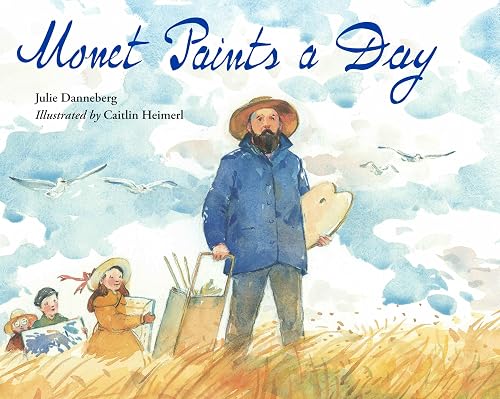
What it’s about: In November 1885, Claude Monet was staying in Étretat, France, painting the seaside village outdoors. One morning he carried all his supplies and half-finished paintings out to the cliffs to paint the rock arch called the Manneporte, and became so absorbed in catching the light that he forgot to watch the incoming tide. Based on a true incident, with excerpts from the painter’s own writing throughout.
Why I love it for art class: This is a perfect pairing with Linnea. Students see why Impressionists painted outside and worked so quickly: the light kept changing. The true story of the tide has a little drama to it, which keeps upper elementary listeners hooked.
Talk about it: “Why did Monet have to work so fast?” “How does a place look different in the morning, at noon and in the evening?” “Would you rather paint outside or inside? Why?”
Make it: “Same place, different light”: students draw one simple scene (a tree, a hill, a rock arch) three times on one strip of paper, then color the first in morning colors, the second in midday colors and the third in sunset colors. Drawing prompt: Draw a rock arch by the sea with waves rolling in.
As a sub plan: Read the book, then students draw the same view three times in crayon, showing morning, afternoon and night. Unit tie-in: Artist study: Claude Monet; Impressionism; color and light; seascapes.
10. The Fantastic Jungles of Henri Rousseau by Michelle Markel, illustrated by Amanda Hall

What it’s about: Henri Rousseau wants to be an artist. Not a single person has ever told him he is talented. He is a toll collector, and he is forty years old. But he buys some canvas, paint and brushes and starts painting anyway. This whimsical picture-book biography follows a self-taught artist who never gave up on his dream.
Why I love it for art class: I love sharing this with Grades 3 to 5 because it quietly flips the idea that you have to be “naturally talented” to make art. Rousseau taught himself and kept going. His jungle paintings, full of layered leaves and hidden animals, are also a fantastic way to teach overlapping and foreground, middle ground and background.
Talk about it: “Nobody told Henri he was talented. Why do you think he kept painting?” “Is it ever too late to start something new?” “How does Rousseau make his jungles look deep and full?”
Make it: Layered jungle: students draw or cut leaves in many shades of green, overlapping them from the bottom of the page up, then hide one animal peeking out through the leaves. Drawing prompt: Draw a jungle with an animal hiding somewhere in the leaves.
As a sub plan: Read the book, then students draw a jungle scene with at least five kinds of leaves and one hidden animal, using only green crayons plus one other color. Unit tie-in: Artist study: Henri Rousseau; space and overlapping; shape; rainforest and jungle themes; SEL (perseverance). If you want a full lesson to go with it, my 3rd grade types of lines leopard lesson (a fun jungle animal to pair with it) is a natural next step.
11. Klimt and His Cat by Berenice Capatti, illustrated by Octavia Monaco

What it’s about: Gustav Klimt’s studio is alive with color, paintbrushes and the smell of paint and canvas, and we see it all through the eyes of his loyal cat, Katze. From distracting Gustav’s models to tagging along on his vacations, Katze offers a cat’s-eye view of the artist’s work and thoughts. The illustrations echo Klimt’s own style.
Why I love it for art class: Telling an artist’s story through his cat is a clever hook for 8 to 11 year olds, and the book is written for that age. It sets up Klimt’s use of pattern, gold and decoration, which is one of the most popular upper elementary art lessons for a reason.
Talk about it: “Why do you think the author told this story from the cat’s point of view?” “What kinds of patterns do you notice in Klimt’s art?” “If your pet could tell your story, what would it say?”
Make it: Klimt-inspired Tree of Life: students draw swirling branches and fill the background and branches with spirals, eyes, triangles and other repeated shapes in metallic and warm colors. Drawing prompt: Draw a cat wrapped in a blanket made of patterns.
As a sub plan: Read the book, then students fill a large tree or cat outline with at least six different repeated patterns using markers or colored pencils. Unit tie-in: Artist study: Gustav Klimt; pattern and repetition; Art Nouveau; line. If you want a full lesson to go with it, my Gustav Klimt Tree of Life lesson is a natural next step.
12. Edward Hopper Paints His World by Robert Burleigh, illustrated by Wendell Minor

What it’s about: As a boy, Edward Hopper knew exactly what he wanted to be. On the cover of his pencil box he wrote “EDWARD HOPPER, WOULD-BE ARTIST.” He traveled to New York and Paris to learn his craft, and even though no one wanted to buy his paintings for a long time, he never stopped believing in his dream. He was fascinated by painting light and shadow, and he became one of America’s most celebrated painters, known for works like “Nighthawks.”
Why I love it for art class: Hopper is a wonderful artist for upper elementary because his paintings are about everyday places: diners, houses, streets and lighthouses. The book also carries a strong perseverance message, and the “would-be artist” pencil box is a detail students remember.
Talk about it: “What did Edward write on his pencil box? What would you write on yours?” “Where does the light come from in a Hopper painting? Where are the shadows?” “Why do you think he painted ordinary places instead of famous ones?”
Make it: Light and shadow buildings: students draw a simple house or storefront, decide where the sun is, then color one side light and the other dark and add a long cast shadow on the ground. Drawing prompt: Draw your house or school with the sun coming from one side and long shadows on the ground.
As a sub plan: Read the book, then students design their own “would-be” pencil box label and draw a quiet everyday place in their town with one strong light source. Unit tie-in: Artist study: Edward Hopper; value, light and shadow; American art; architecture and community.
13. Dreamer from the Village: The Story of Marc Chagall by Michelle Markel, illustrated by Emily Lisker

What it’s about: Marc knew he was different from other boys. He saw things they didn’t see. Born to a humble Jewish family in a Russian village, Marc Chagall grew up to paint people, farm animals, religious symbols, visions and feelings in a way no artist had tried before, and he became one of the most celebrated artists of the twentieth century.
Why I love it for art class: Chagall’s floating people and dreamy village scenes are a great entry point to memory and imagination in art. Students in Grades 3 to 5 are ready to paint not just what something looks like, but what it feels like, and this book gives them a reason to try.
Talk about it: “Marc saw things other boys didn’t. What do you think that means?” “Why might an artist paint a cow that is purple or a person who is floating?” “What memory from your own life would make a good dream painting?”
Make it: Memory dream painting: students draw their home or neighborhood small along the bottom of the page, then fill the sky with floating people, animals and objects that are important to them, in bold, unexpected colors. Drawing prompt: Draw yourself floating over your town, holding something you love.
As a sub plan: Read the book, then students draw a “dream” version of their neighborhood where at least three things float in the sky. Unit tie-in: Artist study: Marc Chagall; memory and imagination; color; Jewish heritage and cultural stories.
14. Magritte’s Marvelous Hat by D.B. Johnson

What it’s about: D.B. Johnson tells the surreal story of painter René Magritte and his very mysterious, and very mischievous, hat. The art reflects some of Magritte’s own work, and the text gives readers a playful, simple path into the ideas behind it. Four transparent pages change the pictures as you turn them.
Why I love it for art class: Surrealism is a favorite with Grades 4 and 5, and this is the friendliest introduction I know. The transparent pages are a little magic trick that makes students lean in, and Magritte’s idea of hiding one thing behind another is perfect for a quick, thinking-heavy drawing lesson.
Talk about it: “What is strange or surprising in these pictures?” “What happens when you turn the clear pages?” “Magritte said everything we see hides another thing. What do you think he meant?”
Make it: Surreal “what’s hiding?” portrait: students draw a person (or themselves) wearing a hat or holding an object that covers part of the face, then make the hidden object something unexpected, like an apple, a bird or a cloud. Drawing prompt: Draw a hat that does something no hat should be able to do.
As a sub plan: Read the book, then students draw an ordinary object (a shoe, a cup, a chair) in a very strange place, and give their picture a mysterious title. Unit tie-in: Artist study: René Magritte; Surrealism; imagination; portraits. If you want a full lesson to go with it, my René Magritte Son of Man surrealism lesson is a natural next step.
Picture Books About Women Who Changed Art and Design
Painters, sculptors, animators, architects and scientific illustrators: these women worked in every corner of the art world, often against the odds. Their stories are inspiring for every student, and they widen the picture of who an artist can be.
15. Through Georgia’s Eyes by Rachel Victoria Rodriguez, illustrated by Julie Paschkis

What it’s about: Georgia O’Keeffe saw the world differently from most people. As a child she roamed the prairie with a sketch pad, trying to capture what she saw. At art school she learned to speak in paint on canvas. City life made her feel boxed in, and she found the wide-open space she longed for in the red hills and silent deserts of New Mexico. A Bank Street Best Children’s Book of the Year.
Why I love it for art class: O’Keeffe is one of the best artists to teach close looking and zooming in. This lyrical book shows how her surroundings shaped her art, and it opens a nice conversation about the places that inspire each of us.
Talk about it: “How did Georgia’s surroundings change her art?” “Why do you think she painted flowers so big?” “Where do you feel the most like yourself?”
Make it: Zoomed-in flowers: students choose a real flower or a photo and draw it so large that the petals run off the edges of the paper, then blend chalk or oil pastel from light to dark. Drawing prompt: Draw a flower so close up that it fills the whole page.
As a sub plan: Students use a paper viewfinder (a small square cut in an index card) to find an interesting close-up of a leaf, shell or flower and draw it to fill the page. Unit tie-in: Artist study: Georgia O’Keeffe; scale, value and blending; nature; women in art. If you want a full lesson to go with it, my Georgia O’Keeffe Calla Lily lesson is a natural next step.
16. Me, Frida by Amy Novesky, illustrated by David Diaz

What it’s about: Like a tiny bird in a big city, Frida Kahlo feels lost and lonely when she arrives in San Francisco with her husband, the famous artist Diego Rivera. It is the first time she has left her home in Mexico, and Frida wants to be a painter too. As she explores the city on her own, she finds the inspiration she needs to become one of the most celebrated artists of all time.
Why I love it for art class: Many Frida books cover her whole life; this one zooms in on one turning point, which makes it easier to talk about confidence and finding your own voice. It pairs naturally with Diego Rivera: His World and Ours, further down this list, so students can compare the two artists.
Talk about it: “Why did Frida feel lost in San Francisco?” “What helped her feel brave enough to paint?” “What is something that makes you feel like yourself, even in a new place?”
Make it: Symbolic self-portraits: students draw a portrait of themselves from the shoulders up, then surround it with four objects, animals or plants that tell something about who they are, like Frida’s portraits often do. Drawing prompt: Draw yourself as a bird flying over a city you would love to visit.
As a sub plan: Read the book, then students draw a self-portrait with a decorated border of things that make them feel at home. Unit tie-in: Artist study: Frida Kahlo; portraits and self-portraits; symbolism; Hispanic Heritage Month; women in art. If you want a full lesson to go with it, my Frida Kahlo portrait lesson is a natural next step.
17. Pocket Full of Colors: The Magical World of Mary Blair, Disney Artist Extraordinaire by Amy Guglielmo and Jacqueline Tourville, illustrated by Brigette Barrager

What it’s about: Mary Blair lived her life in vivid, wild color. From her imaginative childhood to her career as an illustrator, designer and animator for Walt Disney Studios, Mary would not play by the rules. At a time when the studios wanted to hire men and think in black and white, she painted twinkling emerald skies, peach giraffes with tangerine spots and magenta horses that could fly.
Why I love it for art class: Students light up when they hear the artist behind the movies they know was a woman who broke the rules with color. It is a joyful way to teach color schemes, and it shows students that illustration, animation and design are real art careers.
Talk about it: “What made Mary Blair’s colors so different from what other artists were doing?” “Why do you think the studios wanted to ‘think in black and white’?” “Which color combination from the book would you like to try?”
Make it: Unexpected color animals: students draw an animal using simple shapes, then choose a color scheme (complementary, analogous or warm and cool) and paint it in colors that animal would never be, like a peach giraffe with tangerine spots. Drawing prompt: Draw a magenta horse that can fly.
As a sub plan: Read the book, then students color a simple animal drawing using only three colors that are not realistic, and name their color scheme. Unit tie-in: Element of art: color and color schemes; illustration and animation; art careers; women in art. If you want a full lesson to go with it, my Grade 3 color wheel fish lesson is a natural next step.
18. Ruth Asawa: A Sculpting Life by Joan Schoettler, illustrated by Traci Van Wagoner

What it’s about: This picture-book biography follows Ruth Asawa from the Japanese American internment camps to the creation of the San Francisco School of the Arts. Known as the “Fountain Lady” of San Francisco for the many fountains she designed, Asawa experimented with unusual materials, using lines, space and wire to create three-dimensional sculptures.
Why I love it for art class: Asawa is a powerful artist to introduce in Grades 4 and 5, both for her art and for her story. Her wire sculptures make the leap from two-dimensional line to three-dimensional form easy to see, and her life opens important, age-appropriate conversations about injustice and resilience.
Talk about it: “How did Ruth Asawa use line to make a sculpture?” “What do you think ‘drawing in space’ means?” “How did art help Ruth through hard times?”
Make it: Line in space: students bend pipe cleaners or soft craft wire into a loopy, connected sculpture that can stand or hang, then draw a contour drawing of their sculpture from two different sides. Drawing prompt: Draw a line that loops and twists until it becomes a shape.
As a sub plan: Read the book, then students make a continuous line drawing (never lifting the pencil) of a shell, plant or their own hand. Unit tie-in: Line and form; sculpture; Asian American and Pacific Islander Heritage Month; women in art.
19. The World Is Not a Rectangle: A Portrait of Architect Zaha Hadid by Jeanette Winter

What it’s about: Zaha Hadid grew up in Baghdad, Iraq, and dreamed of designing her own cities. After studying architecture in London, she opened her own studio and started designing buildings. As a Muslim woman she faced many obstacles, but she worked hard for many years and reached her goals, and today her buildings stand all over the world. A Washington Post Best Children’s Book of 2017.
Why I love it for art class: Architecture is often missing from the art room, and this book is the perfect door into it. The title alone gets students thinking, and Hadid’s curving buildings are a great way to teach organic versus geometric shape. It is also a strong story about persistence.
Talk about it: “What do you think the title means?” “How are Zaha Hadid’s buildings different from the buildings in your town?” “What obstacles did she face, and how did she keep going?”
Make it: “Not a rectangle” buildings: students design a building using only curves and flowing organic shapes, drawn first in pencil and then built as a paper relief with strips of curled cardstock. Drawing prompt: Draw a building inspired by something in nature, like a wave, a shell or a sand dune.
As a sub plan: Read the book, then students design a dream building for their town with no straight lines, and label what happens inside. Unit tie-in: Architecture; geometric and organic shape; women in art and design; Arab American Heritage Month.
20. The Girl Who Drew Butterflies: How Maria Merian’s Art Changed Science by Joyce Sidman

What it’s about: Newbery Honor author Joyce Sidman introduces Maria Sibylla Merian, one of the first female entomologists and one of the first naturalists to observe live insects directly. In a time when bugs were thought to be “born of mud,” Merian was one of the first to document the metamorphosis of the butterfly. The book is richly illustrated with Merian’s own paintings. A Robert F. Sibert Medal winner.
Why I love it for art class: This nonfiction biography is written for ages 10 to 12, so it is best for Grade 5 and a great bridge into middle school. It shows students that careful observation and drawing can change what people know about the world, which makes it ideal for an art and science connection.
Talk about it: “Why did people long ago believe bugs came from mud?” “How did Maria’s drawings help prove them wrong?” “Why might an artist and a scientist both need to look closely?”
Make it: Life cycle studies: students draw the four stages of a butterfly’s life (egg, caterpillar, chrysalis, butterfly) on one page with a plant from its habitat, in watercolor and fine-line pen, adding labels like a naturalist’s notebook. Drawing prompt: Draw a caterpillar and the butterfly it will become.
As a sub plan: Students draw a life cycle page of any insect using colored pencils, with a label and one fact for each stage. Unit tie-in: Art and science (nature journaling, observational drawing); spring; women in art and science. If you want a full lesson to go with it, my Spring Butterfly art lesson is a natural next step.
Collage, Murals and Art About Community
These books are about art that tells the story of a place and its people, from Matisse’s cut paper to Bryan Collier’s collage and Diego Rivera’s murals. They are some of my favorites for MLK Day, Black History Month, Hispanic Heritage Month and any collaborative class project.
21. The Iridescence of Birds: A Book About Henri Matisse by Patricia MacLachlan, illustrated by Hadley Hooper

What it’s about: If you were a boy named Henri Matisse growing up in a dreary town in northern France, what would your life be like? Would it be full of color and art, of lines and dancing figures? This beautiful, unusual picture book by Newbery Medal winner Patricia MacLachlan imagines the childhood that shaped one of the world’s most famous artists.
Why I love it for art class: It is short and poetic, so it works as a calm opener for any Matisse unit. The question-based text invites older students to think about how the things around us as children can grow into the art we make later.
Talk about it: “What do you think young Henri saw and noticed?” “How might a gray, dreary town make someone want color?” “What from your childhood might show up in your art one day?”
Make it: Matisse-style cut paper portrait: students cut a simple face and shoulders from colored paper, then add a bold patterned background of cut shapes, wavy lines and leaves, gluing the layers so the colors sit side by side. Drawing prompt: Draw a window looking out at the most colorful place you can imagine.
As a sub plan: Read the book, then students draw a room from their childhood full of patterns and bright colors. Unit tie-in: Artist study: Henri Matisse; color; pattern; cut paper and collage. If you want a full lesson to go with it, my Henri Matisse cut paper collage portrait lesson is a natural next step.
22. Henri Matisse: Drawing with Scissors by Jane O’Connor, illustrated by Jessie Hartland

What it’s about: Keesia and Henri Matisse share a birthday, New Year’s Eve, so she picks him for her artist report. She discovers that during his long career Matisse made paintings, sculpture, books and costumes, and her favorite: his cut-outs, which he called “drawing with scissors.” The report includes about 20 of Matisse’s works plus Keesia’s own art in his style, like cut-out leaves, drawings through windows and fauvist animals.
Why I love it for art class: Because it is written as a student’s artist report, this book is a ready-made model for research projects in Grades 3 to 5. It also explains Matisse’s cut-outs clearly enough that students can try the technique right away.
Talk about it: “Why did Matisse call his cut-outs ‘drawing with scissors’?” “What did Keesia include in her report? What would you include in yours?” “How are cut-paper shapes different from drawn shapes?”
Make it: Drawing with scissors: students cut organic shapes freehand (no pencil lines first) from painted or colored paper, then arrange them on a contrasting background before gluing. Talk about positive and negative shapes with the leftover pieces. Drawing prompt: Cut or draw five leaf shapes that look like they are dancing.
As a sub plan: Students make a one-page artist report about Matisse with a title, three facts from the book and a small cut-paper or drawn design in his style. Unit tie-in: Artist study: Henri Matisse; shape (organic, positive and negative); collage; artist research and writing. If you want a full lesson to go with it, my Henri Matisse abstract paper collage lesson is a natural next step.
23. Martin’s Big Words: The Life of Dr. Martin Luther King, Jr. by Doreen Rappaport, illustrated by Bryan Collier

What it’s about: This picture-book biography brings Dr. Martin Luther King, Jr.’s life and message to young readers through powerful collage art and Dr. King’s own words. Growing up in the segregated South, he was inspired by his mother’s belief in equality and his father’s sermons, and he became one of the most gifted speakers of all time, preaching love over hate. A Caldecott Honor and Coretta Scott King Honor book.
Why I love it for art class: Bryan Collier’s collage illustrations make this as much an art book as a history book. It is my go-to read for MLK Day and Black History Month in the art room, and the idea of “big words” gives students a meaningful focus for their own work.
Talk about it: “What ‘big words’ of Dr. King’s do you remember from the book?” “How does collage help tell this story?” “What is one big word that matters to you, and why?”
Make it: Big words collage: students choose one word that stands for something they believe in (kindness, peace, fairness), write it in large hand-drawn letters, and build a collage background from magazine pieces, patterned paper and paint. Drawing prompt: Draw a speech bubble with one “big word” inside and fill the space around it with pictures of what that word means.
As a sub plan: Read the book, then students design a poster for one of their own “big words” using bubble or block letters and colored pencil. Unit tie-in: MLK Day and Black History Month; collage and mixed media; typography; SEL (kindness and fairness). If you want a full lesson to go with it, my MLK Day portrait lesson is a natural next step.
24. Jake Makes a World: Jacob Lawrence, A Young Artist in Harlem by Sharifa Rhodes-Pitts, illustrated by Christopher Myers

What it’s about: This picture book follows young Jacob Lawrence as he finds inspiration in the colors and characters of his Harlem community: his mother’s apartment with brightly colored walls and intricate patterns, streets full of faces, sounds, rhythms and smells, and the art studio he goes to each day after school, where he transforms his everyday world on an epic scale. It includes a reproduction of an actual work from Lawrence’s Migration Series.
Why I love it for art class: I love that it shows Lawrence as a kid finding art in his own neighborhood. It encourages students to see their own streets, homes and families as worthy subjects. Lawrence’s flat shapes and limited colors are also very approachable for this age.
Talk about it: “Where did Jake find ideas for his art?” “What patterns and colors do you notice in his home and neighborhood?” “What would you show if you made a picture of your own neighborhood?”
Make it: My neighborhood in shapes: students draw a scene from their street or community using flat, simple shapes, then paint it with a limited palette of four or five colors, repeating each color in several places across the picture. Drawing prompt: Draw the view outside your front door, with as many people as you can fit.
As a sub plan: Read the book, then students draw a busy scene of a place in their community using only four crayon colors. Unit tie-in: Artist study: Jacob Lawrence; shape and color; community and storytelling; Black History Month.
25. A Splash of Red: The Life and Art of Horace Pippin by Jen Bryant, illustrated by Melissa Sweet

What it’s about: As a child in the late 1800s, Horace Pippin loved to draw. He drew pictures for his sisters, his classmates and his coworkers, and even during World War I he filled his notebooks with drawings from the trenches, until he was shot. Back home, he couldn’t lift his right arm and couldn’t make art. Slowly, with lots of practice, he found his way back to it. Winner of the Robert F. Sibert Honor, the Schneider Family Book Award and the Orbis Pictus Award.
Why I love it for art class: This is one of the most moving artist biographies for Grades 3 to 5. Pippin’s story is about perseverance in a very real way, and the “splash of red” in the title gives you an easy art focus: how one repeated color can tie a whole picture together.
Talk about it: “Why was drawing so important to Horace?” “How did he keep going after he was hurt?” “Look at how red is used in the pictures. Where does your eye go first?”
Make it: One splash of red: students draw a scene from their own life (a meal, a game, a room at home) in browns, grays and soft colors, then add red in three places to lead the viewer’s eye around the picture. Drawing prompt: Draw a room in your home and add three things that are red.
As a sub plan: Read the book, then students draw a memory using only pencil plus a red crayon, repeating the red at least three times. Unit tie-in: Artist study: Horace Pippin; color and emphasis; Black History Month; Veterans Day; SEL (perseverance).
26. Diego Rivera: His World and Ours by Duncan Tonatiuh

What it’s about: Diego Rivera, one of the most famous painters of the twentieth century, was once a mischievous little boy who loved to draw. He studied art in Spain and France as a young man and then returned home to Mexico. Award-winning author and illustrator Duncan Tonatiuh, who drew inspiration from Rivera for his own art, helps young readers understand why Rivera’s work matters and shows them that they, too, can tell stories through art. A Pura Belpré Illustrator Award winner.
Why I love it for art class: The “his world and ours” idea is a brilliant hook for upper elementary: it asks students what Rivera might paint if he were alive today. That leads straight into community murals, and it pairs well with Me, Frida for a compare-and-contrast lesson.
Talk about it: “What did Diego like to paint about his world?” “What would Diego paint if he lived in our town today?” “Why do you think murals are painted where everyone can see them?”
Make it: Class mural panels: each student designs one panel showing a person at work in your community (a bus driver, a farmer, a nurse, a teacher). Line the panels up on a long wall to make one class mural. Drawing prompt: Draw someone in your community doing their job.
As a sub plan: Read the book, then students draw a “Then and Now” picture: one thing Diego painted on one side, and what that might look like in their town today on the other. Unit tie-in: Artist study: Diego Rivera; murals and public art; community; Hispanic Heritage Month.
27. Maybe Something Beautiful: How Art Transformed a Neighborhood by F. Isabel Campoy and Theresa Howell, illustrated by Rafael López

What it’s about: Mira lives in a gray city neighborhood until a muralist arrives and, with his paints and brushes, brings color, joy and hope to the community. Based on the true story of the Urban Art Trail in San Diego, California, it shows how art can transform a place, and how even the smallest artists can do something big. A Tomás Rivera Book Award winner and ALA Notable Children’s Book.
Why I love it for art class: It is the perfect book to launch a collaborative or community art project. Students see that art isn’t only something that hangs in a museum; it can change how a whole neighborhood feels.
Talk about it: “How did the neighborhood change after the mural?” “How can color change the way a place feels?” “Is there a place at our school that could use ‘something beautiful’?”
Make it: Plan a school mural: in small groups, students choose a gray or plain spot at school, take a photo or draw it, and design a colorful mural for it on paper. Vote on a favorite and paint a version on a long roll of paper. Drawing prompt: Draw a plain wall, then cover it with a mural of your own design.
As a sub plan: Read the book, then each student decorates one square tile of paper with a bright design. The squares can be joined into a class “mural” when you return. Unit tie-in: Murals and community art; color; collaboration; Hispanic Heritage Month.
Art Meets Science, Nature and Architecture
Some of the best art lessons for this age sit right where art meets science. These books follow artists who looked closely at snowflakes, birds, spirals, mountains, machines and domes, and they make a perfect bridge to STEAM, nature journaling and sketchbook habits.
28. Snowflake Bentley by Jacqueline Briggs Martin, illustrated by Mary Azarian

What it’s about: From the time he was a boy, Wilson Bentley was captivated by snow. Where other people saw cold and inconvenience, he saw tiny, one-of-a-kind works of art. With his parents’ encouragement he got a camera and a microscope that let him photograph snowflakes, and over the decades he carefully documented hundreds of them. A Caldecott Medal winner.
Why I love it for art class: Bentley is part artist, part scientist, which makes him a perfect winter read for Grades 3 to 5. His story leads naturally into radial symmetry, one of the most satisfying concepts to teach this age.
Talk about it: “What did Wilson see in snowflakes that other people missed?” “Why do you think he kept going even when people didn’t understand his work?” “What do all snowflakes have in common? What makes each one different?”
Make it: Radial symmetry snowflakes: students fold and cut paper snowflakes, then draw a large six-part radial design with white crayon or oil pastel on dark paper and wash over it with watercolor. Drawing prompt: Draw a snowflake with six matching arms, each one different from any snowflake you have drawn before.
As a sub plan: Read the book, then students draw a six-part snowflake design inside a circle using a ruler and a pencil, and color it in cool colors. Unit tie-in: Winter; radial symmetry and balance; photography; art and science. If you want a full lesson to go with it, my winter snowflake art and writing lesson is a natural next step.
29. The Boy Who Drew Birds: A Story of John James Audubon by Jacqueline Davies, illustrated by Melissa Sweet

What it’s about: More than anything, young James Audubon loved being outdoors watching birds. In the fall of 1804 he was determined to find out whether the birds nesting near his Pennsylvania home would really come back the next spring. Through careful observation he laid the foundation for much of what we know about bird migration. Illustrated by Caldecott Honor illustrator Melissa Sweet.
Why I love it for art class: It turns observation into an adventure, and it is a natural lead-in to sketchbook and nature-journal habits. Read it in the fall when birds are on the move, or pair it with The Sky Painter below.
Talk about it: “What question was James trying to answer?” “How did drawing help him study birds?” “What could you observe outside our school this week?”
Make it: Bird field-guide page: students choose a local bird, study a photo, and draw it in pencil with labels for the beak, wing, tail and feet, then add watercolor and one fact about where it goes in winter. Drawing prompt: Draw a bird you have seen near your home, from the side.
As a sub plan: Read the book, then students make a “bird watcher’s page”: a pencil drawing of a bird from a photo with three labels and a short note. Unit tie-in: Nature journaling and observational drawing; art and science; fall migration; winter birds. If you want a full lesson to go with it, my winter bird art lesson is a natural next step.
30. The Sky Painter: Louis Fuertes, Bird Artist by Margarita Engle, illustrated by Aliona Bereghici

What it’s about: Louis loves to watch birds. He cares for injured birds and studies how they look and move. His father wants him to become an engineer, but Louis dreams of being a bird artist, and to reach that dream he practices, practices, practices. He learns from the art of John James Audubon, then begins to paint living, flying birds in their natural habitats. Louis Agassiz Fuertes is now known as the father of modern bird art, and his paintings for habitat exhibits at the American Museum of Natural History in New York are still loved by visitors today.
Why I love it for art class: Read it right after The Boy Who Drew Birds and students get a lovely “artist learns from artist” connection. The message about practice is just right for upper elementary students who are starting to compare their drawings to others.
Talk about it: “How did Louis learn from Audubon?” “Why did Louis want to paint birds flying instead of standing still?” “What is something you have gotten better at by practicing?”
Make it: Birds in motion: students practice quick gesture sketches of birds in flight from photos or video (30 seconds each), then choose one to develop into a finished painting with its habitat in the background. Drawing prompt: Draw a bird in the middle of taking off.
As a sub plan: Students do a page of six quick bird sketches from photos, then pick their best one to color in. Unit tie-in: Observational drawing and gesture; animals and habitats; art careers (scientific illustration); spring. If you want a full lesson to go with it, my Spring Hummingbird art lesson is a natural next step.
31. Swirl by Swirl: Spirals in Nature by Joyce Sidman, illustrated by Beth Krommes

What it’s about: What makes a tiny snail shell so beautiful? Why does that shape show up in nature again and again: in rushing rivers, in a flower bud, even inside your ear? A Newbery Honor poet and a Caldecott medalist celebrate the beauty and usefulness of spirals, from fiddleheads to elephant tusks and from crashing waves to spiraling galaxies, with poetry and scratchboard illustrations.
Why I love it for art class: It is poetry, science and art in one, and Krommes’s scratchboard illustrations are a beautiful model for a texture and line lesson. Older students appreciate the science; everyone loves hunting for spirals afterward.
Talk about it: “Where are spirals hiding in nature?” “Why do you think the spiral shape is so useful?” “How do you think scratchboard art is made?”
Make it: Scratch-art spirals: students cover a paper with bright crayon, add a layer of black crayon or tempera mixed with dish soap, then scratch a spiral from nature (a shell, a fern, a wave, a galaxy) with a wooden stick, using lines to add texture. Drawing prompt: Draw five things from nature that have a spiral in them.
As a sub plan: Read the book, then students go on a “spiral hunt” around the room or through the pictures and draw six spirals they find, labeling each one. Unit tie-in: Line, pattern and texture; art and science; poetry; nature.
32. Hokusai: The Man Who Painted a Mountain by Deborah Kogan Ray

What it’s about: In her own glowing paintings and clear text, Deborah Kogan Ray tells the life story of the Japanese artist Hokusai (1760 to 1849). He rose from poverty, taught himself to draw, became the promising pupil of a great master, and then broke with tradition to become one of the most important and influential artists in the world. The endpapers show drawings from Hokusai’s sketchbooks, and the book includes one of his famous Thirty-six Views of Mount Fuji.
Why I love it for art class: Written for ages 7 to 12, it is a great fit for Grades 3 to 5. Hokusai is a fantastic artist for teaching line, pattern and printmaking, and the sketchbook endpapers are a perfect reason to start a sketchbook habit.
Talk about it: “How did Hokusai teach himself to draw?” “Why do you think he painted the same mountain again and again?” “What can you learn by looking at an artist’s sketchbook?”
Make it: Great wave landscapes: students draw a mountain small in the distance and a huge curling wave in the foreground with claw-like tips, then outline in black and color in blues, using value from light to dark. Drawing prompt: Draw a mountain you could see from your window, then draw it again in a different season.
As a sub plan: Read the book and look at the sketchbook endpapers, then students fill a page with quick sketches of one object from six different angles. Unit tie-in: Artist study: Hokusai; Japanese art and printmaking; line and pattern; landscapes; sketchbook practice. If you want a full lesson to go with it, my Great Wave Japanese art lesson is a natural next step.
33. Leonardo and the Flying Boy: A Story About Leonardo da Vinci by Laurence Anholt

What it’s about: Zoro, a pupil of the great Leonardo da Vinci, discovers that his master is building a mysterious flying machine. This story, part of Laurence Anholt’s series of picture books about famous artists, is based on a true event.
Why I love it for art class: Leonardo was an artist, inventor and scientist, and this story makes that real for kids through the eyes of his young apprentice. It is a great lead-in to sketchbook inventions and to the idea that drawing is a way of thinking, not just a way of making pictures.
Talk about it: “What do you think Zoro felt when he found the flying machine?” “Why might an inventor draw an idea before building it?” “What would you invent if you could make anything fly?”
Make it: Leonardo-style invention pages: students design a flying machine in pencil on tea-stained paper, with labeled parts, notes in the margins and small detailed sketches of how each part works. Drawing prompt: Draw a machine that could help a person fly, and label three parts.
As a sub plan: Read the book, then students draw an invention notebook page with a sketch, labels and three sentences explaining how it works. Unit tie-in: Artist study: Leonardo da Vinci; the Renaissance; art and STEAM; sketchbooks and design.
34. Pippo the Fool by Tracey E. Fern, illustrated by Pau Estrada

What it’s about: The Cathedral of Santa Maria del Fiore in Florence was a marvel of art, architecture and engineering, but it was missing its crown: a dome. The city fathers invited the finest masters to compete for the chance to design it. Filippo Brunelleschi, known around Florence as Pippo the Fool, knew this was his chance: “If I can win the contest, I will finally lose that nickname once and for all!” The book tells the story of how Brunelleschi’s Dome came to be. A Junior Library Guild selection.
Why I love it for art class: Students love an underdog, and the contest storyline gives architecture a little drama. It pairs perfectly with Leonardo and the Flying Boy for a Renaissance mini-unit, and it shows that art and engineering often go hand in hand.
Talk about it: “Why did people call him Pippo the Fool?” “What makes building a dome so hard?” “Have you ever had to prove someone wrong about you?”
Make it: Dome design challenge: students sketch a dome for a building in their town, then build a small version from paper strips, cardstock or recycled materials and test whether it can hold up a small book. Drawing prompt: Draw your town with one amazing new building on the skyline.
As a sub plan: Read the book, then students design an entry for a “design the dome” contest: a labeled drawing of their dome with a short paragraph about why it should win. Unit tie-in: Architecture; the Renaissance; form; STEAM and engineering.

Quick Tips for Picture Books in a Grades 3 to 5 Art Room
- Pair a book with a real artwork. Put the artist’s own painting on the board beside the book’s illustration and let students compare.
- Use books to start research. Henri Matisse: Drawing with Scissors is written as a student’s artist report, which makes it a great model for a short artist research project.
- Try a book pair. Me, Frida with Diego Rivera: His World and Ours; The Boy Who Drew Birds with The Sky Painter; Leonardo and the Flying Boy with Pippo the Fool. Ask what the two books have in common.
- Keep a sketchbook going. Many of these artists filled sketchbooks. A five-minute drawing prompt after each read-aloud builds the habit fast.
- Let students lead. Older students can read a picture book to a younger buddy class and teach the art activity themselves.
Keep the Art Going
If you’d like your read-alouds and your art lessons to line up all year, my K–8 Art Curriculum Map lays out 36 weeks of art lessons for every grade from Kindergarten to Grade 8, with a picture book suggestion for many of the weeks. You’ll find grade-by-grade ideas on my Grade 3, Grade 4 and Grade 5 art lesson pages, and more artist ideas on my famous artist art lessons page.
Want a few lessons to try right away? Join my Free Art Lesson Library. It’s free, and new lessons land in your inbox. And when you’re ready for a full year of art lessons, videos and printables in one place, take a look at the Artastic Collective.
Teaching younger students too? Don’t miss the best art books for toddlers and preschoolers and the best art picture books for Kindergarten to Grade 2, and keep an eye on my Art Book Lists for Kids page for the middle school list. You can also find my own art activity books for kids on my Ms Artastic bookshelf.
Happy reading, and happy creating!
This post contains affiliate links. As an Amazon Associate I earn from qualifying purchases.
Share this:

Did this help? Leave a reaction
Let's talk about it. Have a question, a photo-worthy result, or a tip for other teachers? Drop it in the comments below.
💬 Leave a comment


